
Phoenix AC Replacement
AC Replacement and Installation
When an older air conditioner keeps failing or cannot keep up with Phoenix-area heat, CTS can compare repair versus replacement and plan an AC installation around your home, access, airflow, system sizing, warranty, and budget.
Replacement Details
Replacing an AC should solve the real comfort problem
AC replacement involves more than swapping one box for another. If the old system had weak airflow, hot rooms, duct problems, poor return air, bad thermostat location, drainage issues, or installation problems, a new unit may not fully solve the comfort complaint unless those issues are checked first.
Before recommending replacement, the estimate should look at the equipment and your home. That can include system age, repair history, cooling performance, airflow, duct condition, access, electrical, drainage, thermostat setup, and how the system performs during Phoenix-area heat. A good install should fit your home and avoid carrying old problems into the new equipment.

Replacement Decision Points
What a good AC replacement estimate should account for
The right answer depends on the equipment, your home, the comfort complaint, and whether repair still makes sense.
Age and repair history
One repair on a newer system is different from repeated breakdowns on older equipment during Phoenix summer.
Comfort and airflow
Hot rooms, weak airflow, duct restrictions, dirty coils, and poor return air can affect whether replacement fixes the problem.
Access and installation details
Attic equipment, rooftop package units, tight side yards, drains, line sets, electrical, and permits can change the installation details.

Replace Or Repair
When AC replacement makes sense
AC replacement may make sense when the system is older, repair costs are rising, major parts are failing, or the unit cannot keep your home comfortable during summer. Repeated capacitor failures, compressor problems, refrigerant leaks, poor airflow, hot rooms, and frequent no-cooling calls can all be signs that the system is becoming unreliable.
One repair on a newer system is different from repeated repairs on an older unit. A replacement recommendation should compare repair cost, system age, condition, warranty status, comfort history, and expected equipment life before replacing the air conditioner.
Repair Option
When repair may still be the better answer
Repair may still be the right answer. If the system is still in reasonable condition and the failure is limited to one repairable part, AC repair may be the better choice. A capacitor, contactor, condenser fan motor, thermostat issue, drain problem, or minor electrical repair may not justify replacing the whole system.
When both options are realistic, the repair option and the replacement option should both be explained. That gives you a clearer decision instead of a single sales pitch. Related no-start problems can overlap with AC won’t turn on calls.


Major Failure
Repair or replace after a major AC failure
A major AC failure should trigger a serious repair-versus-replacement comparison. Compressor problems, refrigerant leaks, repeated electrical failures, failed blower motors, and older systems with poor cooling history can make replacement worth considering.
The decision should compare the repair cost, equipment age, refrigerant type, warranty status, comfort history, and expected remaining life of the system. If repair still makes sense, the estimate should say that. If replacement is the better long-term answer, the reason should be clear. Related warning signs can include AC not cooling, new noises, or burning smells.
System Sizing
System sizing matters in Phoenix
A replacement AC system needs to fit your home. Oversized equipment can cool the thermostat area too quickly, short cycle, leave hot rooms, and fail to move enough air through your house. An undersized system may run constantly and still struggle during Phoenix-area heat.
The estimate should look at your home, existing equipment, ductwork, airflow, insulation, sun exposure, thermostat location, and comfort complaints before recommending AC replacement. Proper system sizing and setup matter as much as the equipment brand. FLIR thermal imaging can also help document hot rooms, duct leakage, or insulation problems when those issues are part of the comfort complaint.


Airflow First
Airflow and ductwork before replacement
A proper AC system installation also depends on the ductwork. If the ducts are undersized, leaking, disconnected, restricted, dirty, poorly routed, or missing enough return air, the new equipment may not perform the way it should.
Before replacement, airflow problems should be checked because they affect comfort, efficiency, and equipment life. That can include return-air problems, weak supply airflow, hot rooms, duct leakage, poor filter setup, bad thermostat location, or existing issues that made the old system work harder than it should. These same issues often show up on AC not cooling calls.
System Type
Split system, package unit, heat pump, or mini-split?
The right replacement plan depends on the type of system already serving your home or building. A split system has indoor and outdoor equipment. A package unit keeps most major components in one cabinet, often on a roof or pad. A heat pump can provide cooling and heating. A ductless mini-split may make sense for certain additions, garages, offices, or rooms that are hard to serve with existing ductwork.
The existing setup, access, electrical, drainage, ductwork, line set, thermostat wiring, and service clearances should be checked before estimating the installation. Different system types have different installation details, and those details matter.

Rooftop Work
Rooftop and package unit replacement
Rooftop and package unit replacements usually involve more details than a simple ground-level condenser swap. Access, roof safety, crane scheduling, curb size, electrical connections, gas connections on gas package units, duct connections, condensate drainage, and startup checks all affect the job.
We work on rooftop package units, heat pumps, gas package units, and commercial-style equipment for the services CTS handles. A clear estimate should explain what equipment is being replaced, how access will be handled, and what installation details are included. Larger rooftop work may overlap with commercial HVAC service.
Difficult Access
Attic air handlers and difficult access
Some AC replacements are straightforward. Others are harder because the indoor equipment is in an attic, closet, garage, tight side yard, roof, or difficult access area. Access affects labor, scheduling, equipment selection, safety, and how cleanly the work can be completed.
Access details should be checked before the estimate is finalized. That includes where the indoor equipment sits, how the old equipment will be removed, how the new equipment will be set, and whether drain, electrical, duct, platform, or service-clearance work is needed.


Install Details
Line sets, electrical, drainage, and thermostat setup
A good AC installation includes more than setting the equipment. The line set, electrical disconnect, breaker, whip, condensate drain, float switch, thermostat wiring, refrigerant charging, and startup checks all affect how the system performs.
If a drain is poorly routed, a float switch is missing, the disconnect is damaged, thermostat wiring is wrong, or the line set needs attention, those items should be addressed as part of the installation plan. Drain problems can also connect to AC leaking water and condensate drain cleaning issues.
Install Quality
Installation quality matters as much as the equipment
Brand and model matter, but installation quality matters just as much. Poor airflow, poor drainage, bad electrical connections, poor equipment placement, poor refrigerant setup, or missed startup checks can shorten equipment life and create comfort problems.
A quality HVAC installation in Phoenix should account for access, airflow, drainage, electrical, thermostat setup, refrigerant charging, equipment clearances, and checking the system after installation. The installed system should fit your home, not just the opening left by the old equipment.

Estimate Details
What happens during an AC replacement estimate
A replacement estimate should start with the existing system and the comfort problem. The estimate should look at the outdoor unit, indoor equipment, thermostat, filters, drain setup, duct connections, access, electrical, line set, equipment age, repair history, and whether the system has been keeping up with your home.
The estimate should also account for details that affect the installation. That may include attic access, rooftop access, crane needs, duct transitions, thermostat setup, drainage, permits, equipment availability, warranty, and scheduling. The estimate should explain the installation, not just list an equipment price.
Equipment Options
Major HVAC brands and replacement options
We work with many major HVAC equipment types and can discuss replacement options based on your home, budget, availability, warranty, efficiency, and installation requirements. Brand matters, but the right choice also depends on sizing, airflow, ductwork, access, and installation quality.
CTS has experience servicing and replacing major HVAC equipment, including brands such as Trane, Carrier, Goodman, Lennox, York, Rheem, Ruud, American Standard, Bryant, Day & Night, and ICP-family systems. The recommendation should match the job instead of forcing one answer for every home.

Efficiency
Efficiency, SEER2, and real-world savings
Newer AC systems may offer better efficiency than older equipment, but energy savings depend on more than the equipment rating. Ductwork, airflow, insulation, thermostat settings, installation quality, maintenance, and how your home is used all affect real-world performance.
During the estimate, efficiency options can be compared without overpromising utility savings. The recommendation should balance comfort, reliability, budget, warranty, and expected performance instead of choosing equipment based only on the highest SEER2 number.
Warranty
Warranty, registration, and CTS labor warranty
Many new AC systems include manufacturer warranty coverage, often around 10 years when registration and manufacturer requirements are met. Warranty details can vary by brand, model, registration, part type, and installation requirements.
CTS currently offers a 2-year labor warranty on installs. During the estimate, the warranty discussion should explain what is covered by the manufacturer, what is covered by CTS labor, and what you should know about registration and maintenance requirements. AC maintenance can also matter for long-term reliability and warranty expectations.


Financing
Financing and project timing
AC replacement is a major expense, especially when a system fails during Phoenix summer. Financing is available for replacement and installation projects, and the available options can be explained during the estimate.
Project timing depends on equipment availability, access, schedule, permits, crane needs if applicable, and the type of system being installed. If the system is completely down, the replacement plan can be prioritized as much as the schedule allows.
Do Not Skip
What not to do when replacing an AC
Do not replace the equipment without looking at airflow, ductwork, thermostat location, drainage, electrical, and access. Do not assume the same size is automatically correct. Do not assume bigger is better. Do not ignore hot rooms, weak airflow, repeated repairs, or drain problems that existed before replacement.
A replacement should fix the cooling problem, not hide it for a short time. The system and installation details should be checked before recommending the equipment and work being planned.
Replacement Service Work
Replacement and installation work
AC installation details can include ground-level equipment, rooftop package units, ductwork, drains, access, and startup checks.
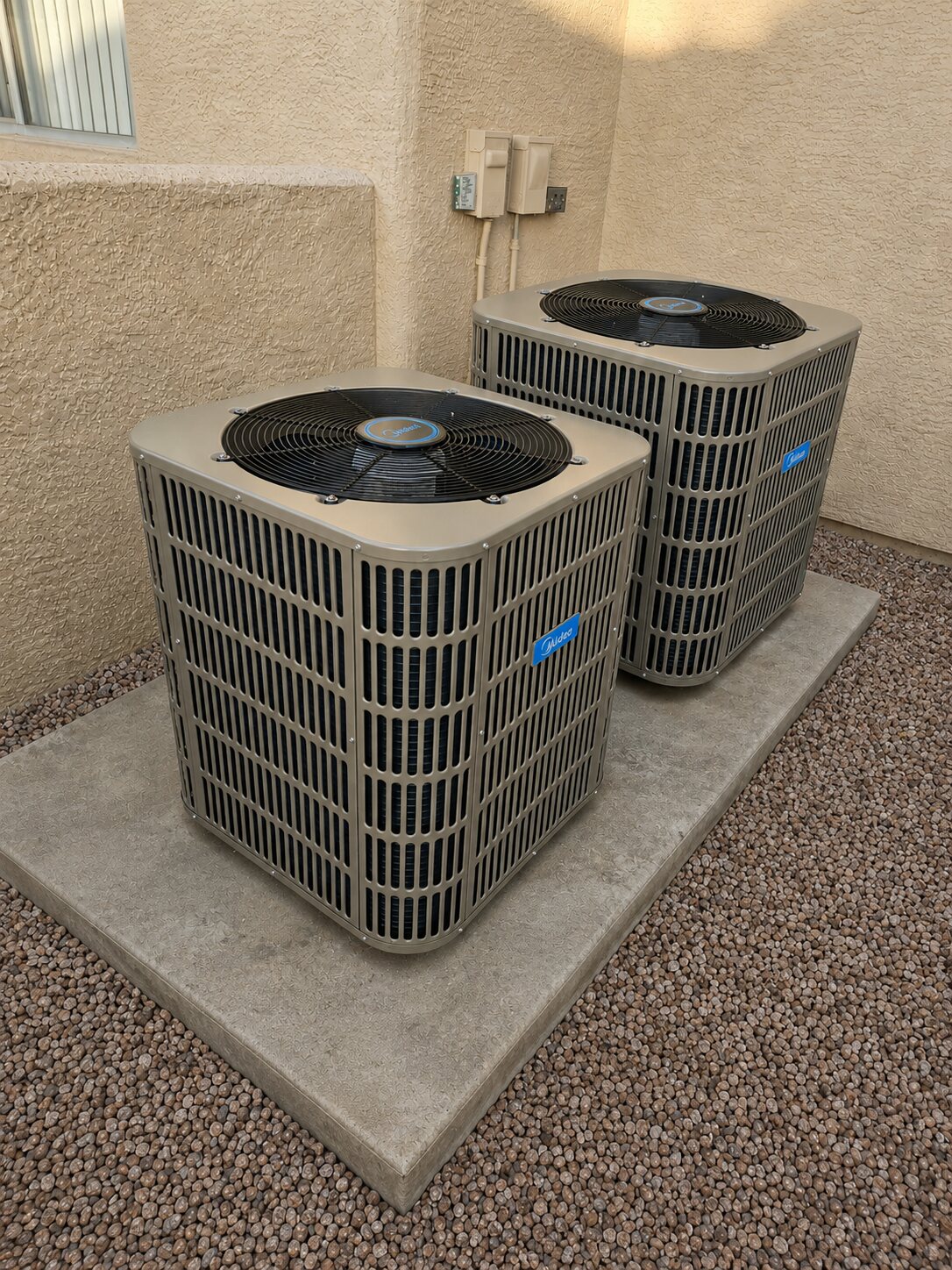
Outdoor condensers
Clean equipment placement matters for service access, airflow around the unit, and long-term maintenance.
Rooftop access
Package unit replacement may need crane scheduling, roof safety, roof curb fit, electrical, duct, and drain details.

Airflow path
Ductwork, returns, transitions, and airflow restrictions can affect whether the new system performs correctly.
Related Diagnostics
Replacement decisions often start with a repair symptom
Use these pages when the replacement question started with a specific failure, comfort complaint, or installation concern.
Airflow and ducts
Hot rooms, poor return air, weak airflow, or duct problems may be part of the replacement plan.
Commercial equipment
Rooftop units, package units, controls, and business access can change the installation details.
AC replacement FAQs
Answers about repair, replacement, maintenance, and service.
When should I replace my AC instead of repairing it?
Replacement may make sense when the system is older, repairs are frequent, repair costs are rising, major parts are failing, comfort is poor, or the unit cannot keep up during Phoenix-area summer heat. CTS compares repair cost, age, condition, comfort, warranty, and expected equipment life before recommending replacement.
Is it worth repairing an older AC system?
If the failure is isolated and the system is still performing well, repair can make sense. If the system has repeated breakdowns, poor cooling, refrigerant concerns, compressor problems, or expensive repairs, replacement is often the better long-term option.
Does CTS offer free AC replacement estimates?
Yes. Free estimates apply to replacement and installation projects. Repair diagnostics are separate from free replacement estimates.
Does CTS install rooftop and package units?
Yes. CTS handles package units, rooftop equipment, split systems, heat pumps, gas package units, and related installation details depending on the job, access, and details.
Can CTS check airflow before replacing my AC?
Yes. Airflow, duct condition, return air, thermostat location, filter setup, coil condition, temperature split, and hot-room complaints should be part of the replacement discussion.
Why does ductwork matter during AC replacement?
A proper AC installation also depends on the ductwork. If ducts are undersized, leaking, restricted, disconnected, or missing enough return air, the new system may still have comfort problems.
Is a bigger AC system better?
An oversized AC can short cycle, leave hot rooms, and fail to run long enough for proper comfort. The replacement system should fit your home, ductwork, airflow, and cooling load.
What should an AC replacement estimate include?
An estimate should account for outdoor equipment, indoor equipment, system type, access, duct transitions, line set, electrical, drainage, thermostat setup, permits, warranty, equipment availability, scheduling, and any comfort problems you want solved.
What warranty does a new AC installation include?
Many systems include manufacturer warranty coverage, often around 10 years when registration and manufacturer requirements are met. CTS currently offers a 2-year labor warranty on installs.
Does CTS offer financing for AC replacement?
Yes. Financing is available for replacement and installation projects.
Can CTS install heat pumps and mini-splits?
Yes. CTS can discuss heat pumps, split systems, package units, rooftop units, and mini-splits after we understand your home or project.
How long does AC replacement take?
Timing depends on system type, access, equipment availability, permits, duct transitions, crane needs, and what you need. Some replacements are straightforward. Others need more information because of attic access, rooftop access, electrical, drainage, or ductwork details.
Licensed Local HVAC Service
Licensed, Bonded, and Insured
Certified Technical Services, known as CTS Air Conditioning, is a local, veteran-owned HVAC and plumbing contractor. The company is licensed, bonded, and insured and has served Phoenix area homes and businesses since 2001.
Licensed for HVAC
HVAC license: ROC 328467. Licensed residential and commercial HVAC service for repair, replacement, and installation work.
Licensed for plumbing
Plumbing license: ROC 341767. Licensed residential and commercial plumbing for water heaters, fixtures, piping, drains, and related work.
Experienced HVAC service
Hands-on HVAC repair and installation experience on homes, commercial rooftops, package units, and water heater calls.
Technical terms on this page
The links below explain common HVAC terms referenced on this page. Each definition is written to help identify the part, measurement, or system condition.
Air Conditioner | Airflow | Air Handler | Blower Motor | Capacitor | Coil | Compressor | Condensate Drain | Condenser Fan | Condenser Fan Motor | Contactor | Disconnect | Duct Leakage | Ductwork | Ductless Mini-Split | Filter | Float Switch | Heat Pump | HVAC | Package Unit | Refrigerant | Refrigerant Leak | Return Air | Roof Curb | Rooftop Unit | SEER2 | Split System | Temperature Split | Thermostat | Transition
Call CTS Air Conditioning
CTS handles AC repair, HVAC service, replacement, maintenance, water heaters, and other plumbing across the Phoenix area.
480-696-5033