
Phoenix Area Service
AC Capacitor Symptoms and Testing in Phoenix
AC capacitors help motors and compressors start and run. In Phoenix heat, a weak capacitor is one of the common reasons an air conditioner hums, starts slowly, trips a breaker, or stops cooling.
What an AC capacitor does
A capacitor stores and releases electrical energy for a motor or compressor. Outdoor condenser fan motors, blower motors, and compressors may use start capacitors, run capacitors, or dual run capacitors depending on the equipment.
- Outdoor unit hums but does not start
- Condenser fan starts slowly or will not spin
- Compressor struggles to start under load
- Breaker trips during startup
- Capacitor, motor, contactor, wiring, and compressor should be checked together
Local service
CTS handles urgent AC repair, AC replacement, commercial HVAC, maintenance, water heaters, and related service across the Phoenix area.
480-696-5033
Capacitor symptoms still need testing
A bad AC capacitor is common, and several other faults can create similar no-cooling symptoms. A motor, compressor, contactor, control board, wiring problem, disconnect issue, or thermostat signal can create similar symptoms.
Phoenix-area HVAC service
CTS works on residential equipment, rooftops, installs, and troubleshooting calls in Arizona conditions.
Serving Phoenix, Mesa, Chandler, Gilbert, Scottsdale, Tempe, Glendale, Surprise, Cave Creek, Queen Creek, Maricopa, and nearby communities.
Testing First
Capacitors are common failures, but they still need testing
AC capacitors fail often in Phoenix heat, but the symptom alone does not prove the capacitor is bad. A humming outdoor unit, slow-starting fan, compressor startup problem, breaker trip, or warm air from the vents can all point toward the capacitor, but those same symptoms can also involve the motor, contactor, compressor, wiring, disconnect, thermostat signal, or control board.
CTS tests the capacitor and checks the parts around it before replacing anything. The capacitor rating, terminal condition, wiring, contactor, current draw, motor operation, and compressor startup behavior all matter. Replacing a capacitor without checking the rest of the circuit can miss the real problem.


Phoenix Heat
Why capacitors fail faster in Phoenix heat
Capacitors sit inside hot outdoor equipment and work every time the fan motor or compressor starts and runs. In Phoenix-area heat, the outdoor unit may run for long hours, sit in direct sun, and operate in cabinet temperatures that are much higher than the air around it.
Heat, age, electrical stress, motor load, poor ventilation, loose terminals, and hard-starting equipment can all shorten capacitor life. That is why a capacitor may test weak before it completely fails. CTS checks the capacitor reading against the rating printed on the part and also checks whether the motor or compressor is drawing abnormal current.
Humming Outdoor Unit
Outdoor unit humming but not starting
An outdoor AC unit that hums but does not start may have a weak capacitor, bad contactor, failed condenser fan motor, compressor startup issue, wiring problem, or power issue. The hum usually means something is being energized, but the equipment is not starting correctly.
If the outdoor unit is humming and the fan is not spinning, shut the system off and call for service. Repeated startup attempts can overheat the motor or compressor. CTS checks the capacitor, contactor, fan motor, compressor, wiring, and incoming power before deciding which part failed.


Fan Not Spinning
Condenser fan not spinning
A bad capacitor can keep the condenser fan motor from starting. Sometimes the outdoor unit hums, the compressor may try to run, and the fan blade does not spin. Other times the fan starts slowly, runs intermittently, or stops after the system heats up.
A stopped condenser fan should be checked quickly because the outdoor unit cannot reject heat correctly without airflow across the condenser coil. The cause may be the capacitor, fan motor, contactor, wiring, control signal, or a mechanical problem with the fan. CTS checks the full fan circuit before replacing parts.
Compressor Startup
Compressor struggling to start
A weak capacitor can make a compressor struggle to start. The system may hum, buzz, click, trip a breaker, start slowly, or fail to cool. But compressor startup problems are serious enough that the capacitor should not be blamed without testing.
CTS checks the capacitor, contactor, voltage, wiring, compressor terminals, current draw, refrigerant-side conditions, and whether the compressor is locked, overheated, or hard-starting. If the capacitor failed because the compressor is under stress, replacing only the capacitor may not solve the problem.


Capacitor Types
Dual run capacitors, run capacitors, and start capacitors
Not every AC capacitor is the same. A run capacitor helps a motor or compressor operate while the system is running. A start capacitor helps some equipment start under load. A dual run capacitor is common in outdoor AC units and can support both the condenser fan motor and compressor in one part.
The replacement must match the correct rating and wiring. The microfarad rating, voltage rating, terminal markings, wiring condition, and equipment requirements all matter. CTS checks the part label and the equipment before installing a replacement.
Visible Failure
Bulging, leaking, burnt, or corroded capacitors
Some failed capacitors are obvious. The top may be swollen, the case may leak oil, the terminals may be burnt, or the connections may be corroded. Those are strong signs the part needs attention.
Other failed capacitors look normal. A capacitor can test weak even if the case is not swollen and the terminals look clean. That is why CTS uses meter testing instead of relying only on appearance. Visual inspection helps, but electrical testing confirms whether the part is within rating.


Ratings And Terminals
Capacitor ratings and terminals matter
A capacitor is not replaced by shape or size alone. The rating printed on the part matters. The microfarad value has to match the equipment requirement, and the voltage rating must be correct for the application.
Terminal markings matter too. On many dual run capacitors, terminals may be marked C, FAN, and HERM. Wiring those terminals incorrectly can damage equipment or create unsafe operation. CTS checks the label, wiring, and equipment before installing the replacement capacitor.
Breaker Trips
Capacitor failure and breaker trips
A weak or failed capacitor can contribute to startup problems that trip a breaker. But a breaker trip should not be treated as a capacitor problem automatically. Repeated breaker trips can also involve a motor, compressor, shorted wire, loose connection, disconnect problem, contactor, or other electrical fault.
Do not keep resetting a breaker that trips again. A breaker is a safety device. CTS checks the capacitor along with the motor, compressor, wiring, contactor, disconnect, and current draw to find out why the system is tripping power.


Burning Smell
Capacitor failure and burning smells
A capacitor problem can show up with a hot electrical smell, burnt terminal, melted wire, or overheated connection. The smell may also come from the contactor, motor, compressor, wiring, disconnect, or another electrical part.
If the AC smells hot, smoky, or electrical, shut the system off and call for service. CTS checks for visible heat damage, weak capacitor readings, loose terminals, damaged wiring, failed contactors, motor problems, and compressor startup trouble.
Repair
Capacitor replacement versus deeper repair
Capacitor replacement may be the right repair when the capacitor is weak or failed and the motor or compressor it supports is still in reasonable condition. That is a common repair.
A deeper repair may be needed when the capacitor failed because the motor is overheating, the fan motor is failing, the compressor is hard-starting, the terminals are burnt, or the wiring and contactor are damaged. CTS checks whether the failed capacitor is the whole problem or only one part of a larger failure.


Fan Safety
Do not push-start the fan
If the outdoor fan will not start, do not try to push the blade with a stick or screwdriver while the unit has power. That is unsafe and does not fix the problem. A fan that needs help starting may have a weak capacitor, failed motor, wiring issue, contactor problem, or other electrical fault.
Turn the system off and call for service. CTS can test the capacitor and fan circuit safely instead of forcing the equipment to run.
Diagnostic Process
How CTS diagnoses capacitor-related calls
A capacitor diagnostic starts with the symptom. CTS checks whether the system is not starting, humming, tripping the breaker, blowing warm air, running the fan slowly, or failing under load.
The diagnostic may include testing the capacitor against its printed rating, checking the terminals, verifying wiring, inspecting the contactor, checking incoming voltage, checking the disconnect, measuring motor or compressor current draw, checking the condenser fan motor, and confirming whether the compressor is starting correctly. Testing should support the capacitor replacement and catch related failures before they cause another service call.


Maintenance
Maintenance can catch weak capacitors before failure
A capacitor can test weak before it completely fails. During AC maintenance, CTS may check capacitor readings, contactor condition, wiring, terminal condition, motor operation, condenser coil condition, and overall startup behavior.
Maintenance can catch weak capacitor readings and visible electrical problems before the system quits on the hottest part of the day, especially in Phoenix heat.
What Not To Do
What not to do when you suspect a bad capacitor
Do not keep forcing the AC to start if the outdoor unit is humming, buzzing, or struggling. Do not keep resetting a breaker that trips again. Do not push-start the fan blade. Do not open the electrical compartment unless you are trained to work around high-voltage equipment and charged capacitors.
A capacitor can hold a charge even after power is off. If the system is acting like a capacitor failed, shut it off if needed and call for service.

Electrical Safety
Capacitors can hold a charge
Turn off power and call for service if you are not trained to test and discharge HVAC capacitors. These parts sit inside high-voltage equipment and can shock you even after the system is off.
Symptom Overlap
Capacitor calls often overlap with other repairs
The same symptom can come from several parts, so a capacitor page should connect to the larger AC diagnostic.
No-start calls
A quiet or humming outdoor unit may involve the capacitor, contactor, thermostat signal, disconnect, wiring, fan motor, or compressor.
Warm-air calls
The indoor blower may move air while the outdoor unit is not removing heat. That can make your home feel like the AC is blowing warm air.
Breaker trips
Startup problems can trip a breaker, but repeated trips can also point to motors, compressor trouble, shorts, or wiring issues.
Capacitor Photos
HVAC capacitor examples
Real parts help explain why both visual inspection and electrical testing matter.
Bulging failed capacitor
A swollen capacitor is a strong visual sign of failure, but testing is still used to confirm the repair.

Good and failed capacitors
A comparison can help explain swelling, corrosion, age, and why appearance alone is not enough.
Ratings and terminals
The rating and terminal markings matter when matching the replacement capacitor to the equipment.
Capacitor testing
Testing confirms whether the capacitor is within rating before parts are replaced.
Motor connection
Capacitor problems are tied to the motor or compressor they help start and run.
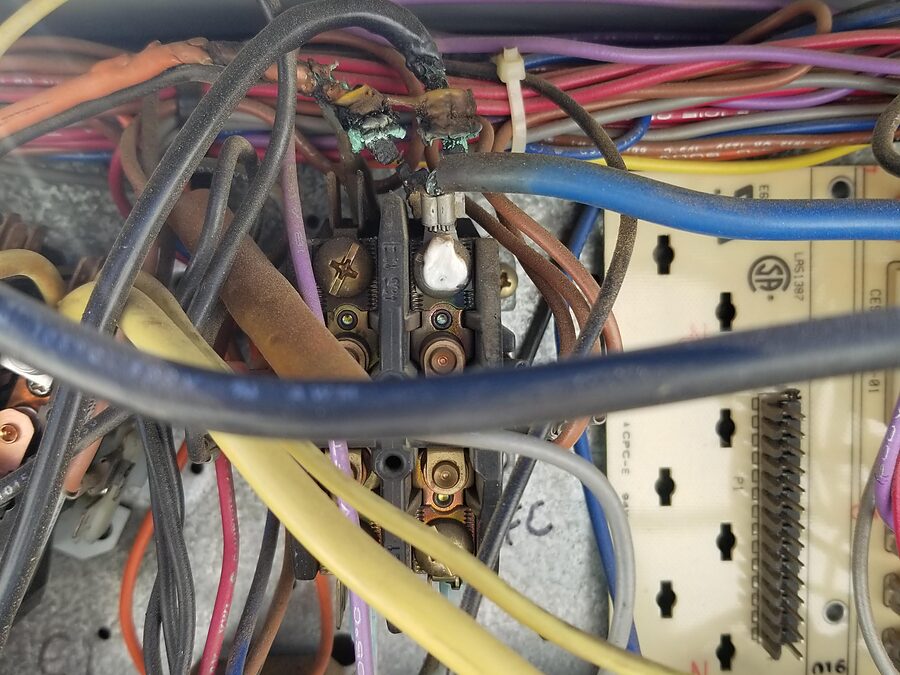
Burnt terminal or wiring
Heat damage may point to a capacitor problem, loose connection, motor issue, or larger electrical fault.
Related AC Repairs
Related capacitor and no-start pages
These pages explain the larger symptoms and parts that often lead to capacitor testing.
Capacitor replacement
Detailed capacitor replacement, testing, safety, and failure explanation.
AC will not turn on
No-start calls can involve capacitors, contactors, wiring, motors, controls, and the compressor.
Fan not spinning
A failed capacitor can stop the outdoor fan, but the motor and wiring also need to be checked.
Compressor not starting
A compressor startup problem may involve the capacitor, contactor, current draw, wiring, or compressor condition.
HVAC contactors
A bad contactor can look like a capacitor problem when the outdoor unit does not start correctly.
Condenser fan motors
Fan motor and capacitor symptoms overlap, so the motor circuit should be checked before parts are replaced.
HVAC capacitor FAQs
Answers about repair, replacement, maintenance, and service.
What does an HVAC capacitor do?
An HVAC capacitor stores and releases electrical energy to help a motor or compressor start or run correctly. Outdoor fan motors, blower motors, and compressors may use start capacitors, run capacitors, or dual run capacitors depending on the equipment.
What are signs of a bad AC capacitor?
Common signs include an outdoor unit humming, condenser fan not spinning, compressor struggling to start, warm air from vents, intermittent cooling, slow fan startup, clicking, buzzing, or breaker trips. Testing is still needed.
Can a bad capacitor make the outside AC unit hum?
Yes. A weak or failed capacitor can cause the outdoor unit to hum while the motor or compressor fails to start correctly. A bad contactor, motor, compressor, wiring problem, or power issue can cause similar symptoms.
Can a bad capacitor stop the condenser fan?
Yes. A failed capacitor can keep the condenser fan motor from starting. The fan motor, wiring, contactor, control signal, and mechanical condition should also be checked.
Can a bad capacitor trip the breaker?
Yes, a capacitor-related startup problem can contribute to a breaker trip. But repeated breaker trips can also involve a motor, compressor, wiring fault, contactor, disconnect, or short. Do not keep resetting the breaker.
Can I replace an AC capacitor myself?
CTS recommends professional testing and replacement. Capacitors can hold a charge and are located inside high-voltage equipment. Incorrect wiring or an incorrect rating can damage equipment or create a safety risk.
Why does the replacement capacitor rating matter?
The microfarad rating and voltage rating must match the equipment requirements. Terminal markings and wiring also matter, especially on dual run capacitors with C, FAN, and HERM terminals.
Does a failed capacitor mean I need a new AC?
Not by itself. A capacitor is often repairable if the rest of the system is in reasonable condition. Replacement may be discussed if the equipment is older, has repeated failures, or the motor or compressor has a larger problem.
Why did my new capacitor fail again?
Repeated capacitor failure may point to heat, motor stress, compressor startup problems, loose wiring, incorrect part rating, dirty condenser coil, poor electrical connections, or another issue that needs to be checked.
Can maintenance catch a weak capacitor?
A capacitor can test weak before it completely fails. Maintenance can catch weak readings, corroded terminals, worn contactors, or startup problems before the system quits.
Should I shut off the AC if the unit hums but does not start?
Yes. If the outdoor unit hums, buzzes, or struggles to start, shut it off and call for service. Repeated startup attempts can overheat motors or the compressor.
What should I tell CTS when calling about a possible capacitor problem?
Mention whether the outdoor unit is humming, the fan is not spinning, the breaker trips, the system blows warm air, the unit starts slowly, or the AC runs intermittently. Photos of the outdoor unit or electrical compartment should only be taken if it is safe and the panel is already open.
Licensed Local HVAC Service
Licensed, Bonded, and Insured
Certified Technical Services, known as CTS Air Conditioning, is a local, veteran-owned HVAC and plumbing contractor. The company is licensed, bonded, and insured and has served Phoenix area homes and businesses since 2001.
Licensed for HVAC
HVAC license: ROC 328467. Licensed residential and commercial HVAC service for repair, replacement, and installation work.
Licensed for plumbing
Plumbing license: ROC 341767. Licensed residential and commercial plumbing for water heaters, fixtures, piping, drains, and related work.
Experienced HVAC service
Hands-on HVAC repair and installation experience on homes, commercial rooftops, package units, and water heater calls.
Technical terms on this page
The links below explain common HVAC terms referenced on this page. Each definition is written to help identify the part, measurement, or system condition.
Air Conditioner | Airflow | Blower Motor | Capacitor | Breaker Trip | Coil | Compressor | Condenser Coil | Condenser Fan | Condenser Fan Motor | Contactor | Control Board | Disconnect | HVAC | Refrigerant | Run Capacitor | Start Capacitor | Thermostat
Call CTS Air Conditioning
CTS handles AC repair, HVAC service, replacement, maintenance, water heaters, and other plumbing across the Phoenix area.
480-696-5033